Essay··checked live the same day
On the Health Room
A room is not a tool. It is a page that tells you which tools exist, and the only work it has to do is describe them accurately. labs.llc’s health room does that eight times over and then, on one card, does not.
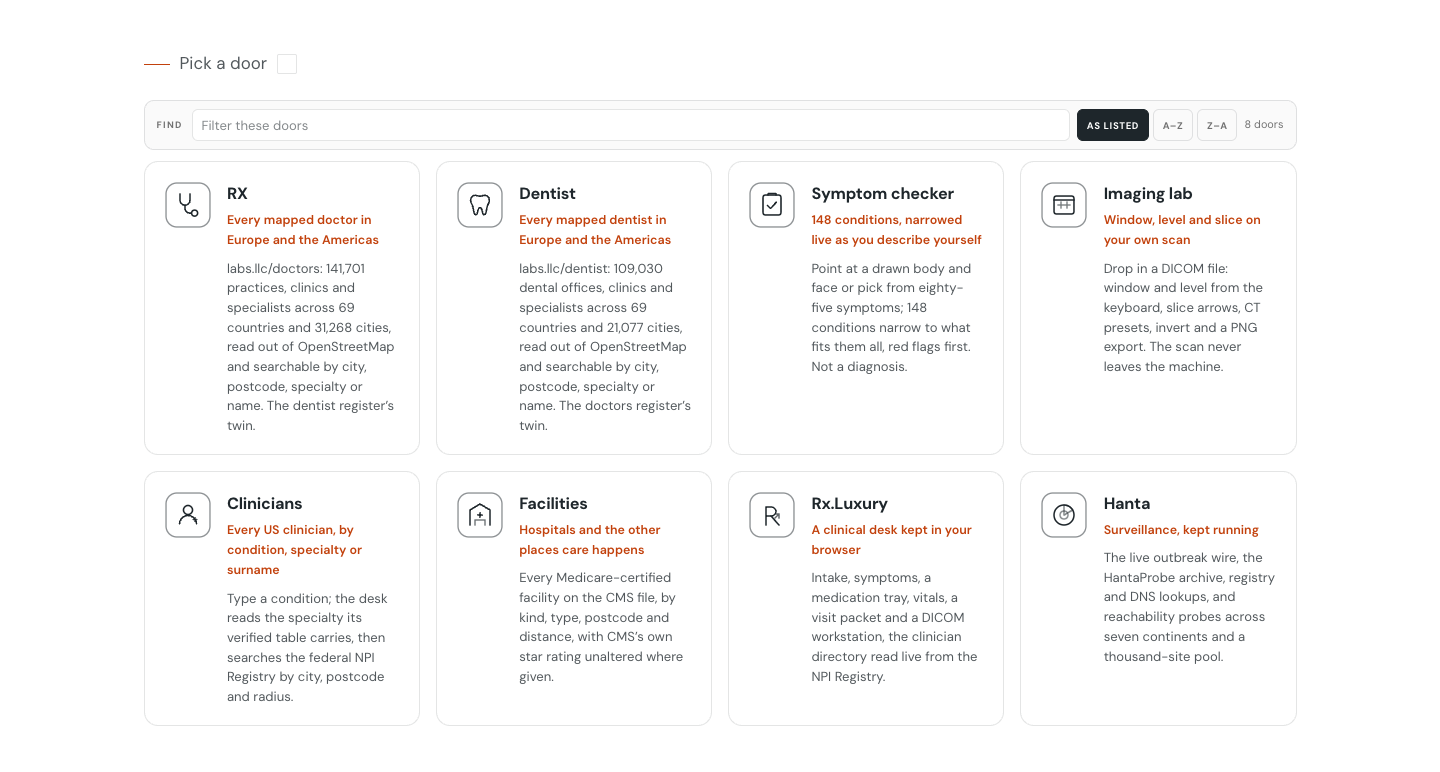
There is a kind of page that almost nobody reviews, because it has no buttons worth pressing and nothing to measure except its sentences. The index page. The room. The thing that stands between a visitor and eight actual instruments and says, in a paragraph apiece, what each one is for. It is the least glamorous surface in any estate and the one where being wrong costs the most, because a visitor who is misdescribed at the door either leaves or arrives at the tool expecting something it never claimed.
labs.llc keeps one of these for its health properties, at labs.llc/health/. Forty-seven kilobytes, self-canonical, titled Health — A clinical desk and an outbreak wire. It holds no data of its own. It runs no search. Its entire function is to be believed.
What it is index to
Eight doors, and the page counts them for you in the corner of its own filter row. Two of them are the map registers — RX and Dentist, which the cards describe as 141,701 practices and 109,030 dental offices across 69 countries, read out of OpenStreetMap. Four are surfaces of a single clinical desk: the symptom checker, the imaging lab, the clinician finder and the facilities search. One is the desk itself, Rx.Luxury. The eighth is Hanta, an outbreak wire that has nothing to do with the visitor’s own body at all, and whose presence here is the room’s one genuinely editorial decision.
That decision is also the room’s best line. Its opening paragraph puts the two halves of the collection back to back: Rx.Luxury is a desk for what is moving through you, and Hanta, it says, “looks the other way” — at what is moving through the world. It is a single sentence of framing and it does more work than the eight cards underneath it, because it tells you the room has a thesis rather than an inventory.
The paragraph that earns the room its credibility
Directly under that, the room does something I did not expect from an index page: it names its sources and then disclaims the things it has decided not to sell you.
“Both read federal registers rather than inventing anybody.” The clinician directory, it says, is NPPES; the hospital list is the CMS facility file behind Hospital Compare — “5,419 Medicare-certified hospitals with the government’s own star rating.” And then: “Neither property carries a rating, a network or an appointment time that nobody keeps.”
I checked the number. At 22:36 UTC on the day I read the room, an unfiltered call to the desk’s own CMS relay came back with a total of 5,419 rows. The room’s figure is its data’s figure, exactly, which is a low bar that a surprising number of index pages fail.
The disclaimer in the third sentence is the more interesting part. Every health directory on the open web is under commercial pressure to add three things: a star rating it computed itself, an insurance network filter, and a bookable slot. All three are revenue. All three are also, at the scale of a 109,030-row map extract, fiction — you cannot know from OpenStreetMap whether a dentist is taking patients on Thursday. The room says it does not carry them. That is a paragraph written by somebody who had the option and declined it, and a reader should notice that the absence is being declared rather than quietly left out.
The same restraint runs through the room’s treatment of the symptom checker, which it introduces with the flattest possible sentence: neither of these is a diagnosis and neither is triage. The checker, it says, shows which recognised conditions share the pattern you describe and which kind of clinician sees them — and it will not tell you what you have, and will not tell you that you are fine. A room index is exactly where a visitor decides how much to trust what is behind the door, and refusing twice on the doorstep is a stronger signal than any badge.
One thing the room does not spell out, and which anybody writing about this collection should: the imaging lab behind the fourth card is a viewer. It opens a DICOM file, windows it, pages through slices and exports a picture. It does not interpret the image, detect anything in it, or produce a report. The room’s card is careful not to claim otherwise — “window, level and slice on your own scan” is precisely what the tool does — but the card is descriptive where the checker’s treatment is explicitly restrictive, and a card that only describes leaves the loudest assumption in the room unaddressed.
Two sentences that are not true of this page
Which brings me to the third card and the closing band.
What it gets wrong
The symptom-checker card is out of date by seventy-one conditions. The card in the screenshot above says “148 conditions, narrowed live as you describe yourself”, and its body repeats it: “148 conditions narrow to what fits them all”. The string 148 occurs five times in the page I fetched at 22:33 UTC on 22 September 2026; the string 219 occurs none. The desk that card points at prints its own count in its own footer — the register holds 219 conditions across 22 regions, described by 85 symptoms — and its counter opens at 219 of 219 still in play. The tool outgrew its summary and the summary was not rewritten.
The closing band counts a room that is not this one. Under the heading “Your file does not leave”, the room’s last paragraph begins “Six of these seven read what you give them entirely in the page” and then lists “the conversion, the search, the metadata, the hidden characters, the clinical record”. There is no converter in this room and nothing here reads hidden characters. Six plus the two it goes on to mention is eight, not seven. I fetched labs.llc/utilities/ at 22:34 UTC to check the obvious suspicion, and found the identical sentence there reading “Six of these ten” — where the inventory does fit. The paragraph is a house block that was moved into the health room and re-counted carelessly, and the arithmetic does not survive a reader who counts the cards.
Neither of these is a safety problem and I want to be precise about that. Nobody is harmed by a card saying 148 when the tool holds 219; the checker itself is correct, and the direction of the error is toward understatement. The borrowed paragraph is a copy-editing miss in a band whose actual claim — that these tools read what you give them in the page — is true of the ones it is describing.
They matter for a different reason. This is a house that has built its entire tone on counting things properly. The registers publish the percentage of their own rows that lack a phone number. The facilities relay refuses to render an unrated hospital as a zero. The checker footer states its three figures every time you open it. In a collection that fastidious, the index page is the one surface where the numbers are written by hand and never checked against anything — and it shows. The fix is not a redesign; it is a build step that reads the register’s own count and writes the card.
The geography the cards only half declare
There is a third thing worth flagging, softer than the two above because it is a matter of emphasis rather than of fact. Six of the eight doors are open to anybody. Two of them are open to Americans.
The room’s top matter is about reach: the registers cover Europe and the Americas, 69 countries, and the two map cards say so in their own text. The clinician finder and the facilities search do not have that reach and cannot, because they are front ends to two United States federal datasets — the NPI registry and the CMS hospital file. The clinicians card is straightforward about it and opens with the words “Every US clinician”. The facilities card does not use the word at all; it says “Every Medicare-certified facility on the CMS file”, which is exact, and which asks the reader to know that Medicare is an American programme before they can work out that the door is shut.
A visitor in Lyon or Lisbon, arriving from a page that has just told them about 69 countries, can reach a hospital search that will never return their hospital. One extra word on one card closes that gap. The room’s standard elsewhere is that a limit gets stated at the door, and here it is stated on one card of the pair and implied on the other.
What the room is for
Judged as what it actually is — a door list — this page does the difficult part well and the easy part badly. The difficult part is describing eight instruments in four lines each without overselling any of them, while telling a visitor which of the eight is about them and which is about the world. It does that, and its refusals are specific enough to be checkable, which is the only kind of refusal worth printing.
The easy part is keeping five hard-coded numbers in step with the files they describe, and on one card it has not. A reader who arrives at the checker will find a better tool than the room promised. That is the forgivable direction for an index page to be wrong in, and it is still wrong.
The health room is an honest page with a stale card. Read it for the framing — the desk that looks at you and the wire that looks at the world — and read the numbers off the desks themselves, because the desks count and the room remembers.